
Equivalent Pace
Transform a flat pace into a treadmill speed and gradient combination.

Uphill performance lab
Assess, plan and improve your uphill profile.
The idea in 53 seconds.
The tool
Prescribe uphill sessions, assess specific uphill capacities and track each athlete’s evolution from one app.
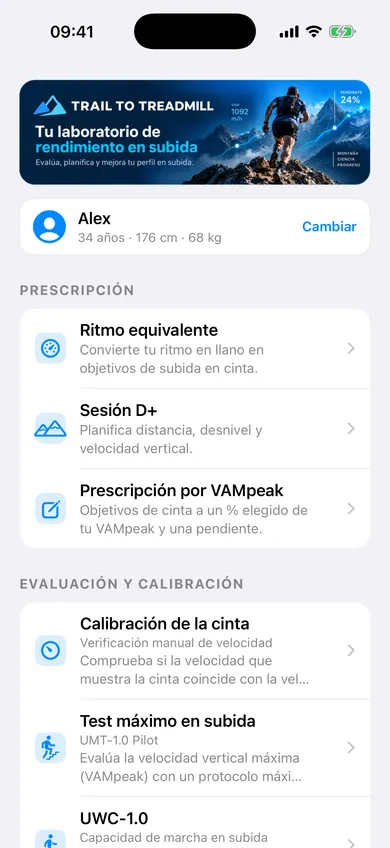
Prescribe
Turn pace, gradient, elevation gain and VAMpeak into specific treadmill targets.
Assess
Analyse VAMpeak, walking, transitions, efficiency, time to limit and durability.
Track
Compare tests, review history and follow how each athlete’s vertical profile changes over time.

Prescription
Bring flat-ground references to the treadmill and prescribe specific uphill sessions using pace, gradient, elevation gain and VAM.
Transform a flat pace into a treadmill speed and gradient combination.
Calculate how long is needed to accumulate a specific amount of elevation gain.
Prescribe uphill intensities from the athlete’s maximum vertical performance.
Assessment
Assess different capacities related to uphill performance and build a more complete profile for each athlete.
Maximal uphill test to estimate maximum vertical performance.
Assess uphill walking capacity and the transition toward running.
Analyse transitions between walking and running on an incline.
Relate external load and heart rate across different intensities and gradients.
Measure how long the athlete can sustain intensities relative to VAMpeak.
Observe mechanical and performance changes associated with fatigue.
Efficiency
Relate external load to heart-rate response and observe how athlete efficiency changes across different inclines.
EF1 and EF2 assess efficiency at intensities relative to VAMpeak and allow longitudinal comparison over time.
Analyse the relationship between speed, VAM and heart rate at moderate inclines.
Compare the athlete’s internal response as vertical demand increases.
Observe how efficiency changes when gradient approaches the most demanding values.
Sensors
Trail to Treadmill can work with external sensors to enrich assessment without making them a requirement for using the app.
Connect a Bluetooth heart-rate strap to record cardiac response during efficiency tests and other assessments.
Use a compatible sensor such as STRYD to add running metrics and analyse mechanical variables.
Sensors are optional and independent. You can use compatible app functions without having every sensor connected.
Evolution
Compare tests, review history and observe how each athlete’s vertical profile changes over time.
Uphill profile
Longitudinal tracking
For coaches
Trail to Treadmill is also designed as a support tool for coaches working with trail runners who need to translate mountain performance to the treadmill.
“The treadmill becomes more than an alternative to the mountain: it becomes a tool for prescription and assessment.”
Adjust speed, gradient, elevation gain and intensity to each athlete’s characteristics.
Use uphill tests to build an individual profile of uphill performance.
Compare results and observe how the athlete evolves throughout the training process.
Methodology
The app combines prescription, measurement and longitudinal comparison to turn treadmill work into useful training information.
Pace, speed, gradient, VAM, elevation gain and duration.
Heart rate, RPE and locomotor context when available.
Use the same treadmill, calibration and protocol whenever you want to compare evolution.
Proprietary protocols are science-informed and should be interpreted within their conditions of use. Trail to Treadmill provides tools for prescription and assessment, but does not replace laboratory physiological assessment.